A spice batch can meet a nominal mesh specification and still contain too many fines, coarse particles, or unstable agglomerates. You will learn how the screen, feed conditions, grinding stage, and test method work together so you can define a meaningful size distribution, investigate variation, and choose a screening setup that protects both product quality and process control.
Key takeaways
- Set the cut point, then verify the complete particle-size distribution.
- Control feed rate, moisture, temperature, and screen loading for accurate separation.
- Send oversize material to regrinding instead of returning it uncontrolled.
- Choose a screen you can inspect, clean, test, and maintain consistently.
How screening changes the particle-size distribution
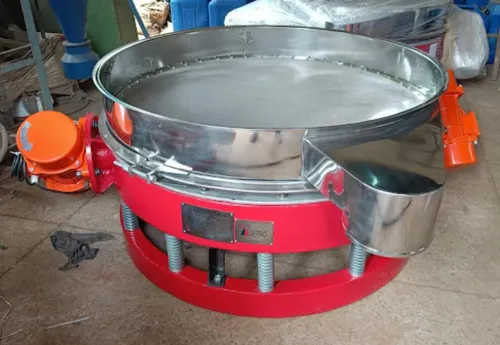
A spices screening machine narrows the particle-size distribution by separating particles at a defined aperture. Undersize particles pass through the mesh, while oversize particles remain above it for removal or rework. The resulting fraction gives you more predictable mouthfeel, colour release, flavour extraction, blending, filling, flowability, and dosage uniformity.
| Fraction | Screen result | Finished-product effect |
|---|---|---|
| Fine or undersize | Passes through the aperture | Greater surface area per unit mass can increase flavour release and extraction, but also raises dust, oxidation exposure, moisture uptake, caking risk, and handling problems. |
| Target fraction | Meets the selected cut point | More even blending, filling, flowability, mouthfeel, colour release, and dose-to-dose flavour. |
| Coarse or oversize | Remains above the mesh | Large particles can produce a gritty mouthfeel, slower flavour extraction, uneven colour release, poor blending, and erratic filling. |
Screening separates by ability to pass an aperture, not by identity or hazard. A mesh will not reliably remove every stone, wire fragment, or metal particle, so retain magnets, metal detection, aspiration, and validated foreign-material controls. Screening is also not a microbial kill step: Salmonella and other pathogens can remain in both fractions.
Use hygienic design, validated treatment where required, environmental control, and microbiological verification for low-moisture spices.
Specify the cut point and verify the full distribution
Mesh count alone is not a particle-size definition. Mesh aperture depends on both the opening size and wire diameter, so two “16-mesh” screens can produce different cuts. Specify the nominal aperture in millimetres or micrometres, the applicable test-sieve standard, the number of decks, and the intended cut point.
Define the acceptance test before production:
- Take a representative composite sample from the beginning, middle, and end of the batch.
- Use a defined sieve stack with controlled loading, documented shaking time and amplitude, and a stated endpoint.
- Weigh every retained fraction and the pan fraction under ISO 2591-1 procedures.
- Record D10, D50, D90, and span, calculated as (D90−D10)/D50.
- Record the target distribution, oversize percentage, fines percentage, moisture, foreign-material findings, and batch-to-batch variation.
A nominal cut point does not prove a consistent distribution. Two lots can both pass a 16-mesh requirement while one contains far more fines and the other carries a heavier coarse tail.
D10 shows where 10% of particles are finer, D50 gives the median size, and D90 identifies the coarse boundary; span exposes the width of that distribution. A written sieve method prevents excessive loading or indefinite shaking from over-reporting fines or hiding retained material.
Control feed conditions that decide separation accuracy
Accurate separation depends on matching feed rate, bed depth, vibration frequency, vibration amplitude, and screen inclination. A deep or fast-moving bed gives particles fewer opportunities to reach an aperture, so throughput rises while separation worsens. Excessive acceleration shortens residence time, throws acceptable particles into the oversize stream, increases dust, and damages brittle spices.
Screen open area and residence time also change with deck loading; recirculation can recover misplaced particles but adds handling, attrition, and heat.
Moisture and oil content can change the duty completely. Damp hygroscopic powder forms soft agglomerates that blind or clog the mesh, while natural oils and essential oils make particles adhere to wires and reduce open area. Hot powder can screen freely at discharge, then behave differently as it cools and absorbs moisture.
Bulk density and temperature therefore belong in the operating record.
| Condition | What goes wrong | Better response |
|---|---|---|
| Damp powder | Blinding and agglomerate classification | Moisture conditioning, dehumidified air, or a different screen surface |
| Oily powder | Adhesion and blocked apertures | Anti-blinding devices or a surface selected for the oil content |
| High acceleration | Dust, attrition, and oversize carryover | Reduce amplitude or frequency and increase residence time |
Increasing vibration is not an unlimited remedy. Anti-blinding devices, dehumidified air, moisture conditioning, or a different screen surface can outperform it. Define whether agglomerates remain intact as product units or are gently deagglomerated before sizing; otherwise the test measures lumps rather than particles.
Build a controlled route from grinding to regrinding
Start by isolating each stream so the grinding and screening process cannot hide its own failures. Inspect ground spice through a magnet or metal trap before screening; remove metal fragments, stones, and other dense contaminants into identified reject containers, while stems, husks, fibres, and seeds follow separate rework or disposal routes.
- Feed the screener at a recorded, controlled rate. Excess loading buries the mesh; excessive vibration can throw usable powder into oversize.
- Collect the accepted fraction in a closed, labelled container showing product, lot, date, and status.
- Send oversize to a defined regrinding oversize material route, or hold it for approved rework. Never return it directly without identity and contamination checks.
| Sample point | What it reveals | Action |
|---|---|---|
| Grinder discharge | Variation already present before separation | Check grinding conditions |
| Screen discharge | Variation created or exposed during separation | Check mesh, loading, blinding, and leakage |
Troubleshoot in this order: grinder gap; rotor or hammer condition; screen integrity and installation; feed rate; moisture; vibration settings; deck loading; then recirculation. Compare matched samples before changing settings blindly. Repeat sieve checks after screen replacement and during production because wear, stretching, damage, screen blinding, or leakage changes aperture and open area.
Finish with sanitation checks: inspect crevices, gasket seats, and accessible product-contact surfaces; confirm tool-free screen changes, gasket compatibility, and cleaning validation. Retained spice dust can cause cross-contact and undermine microbial control.
Choose a screening configuration you can validate and maintain
Compare equipment by the product quality it holds, not by its maximum quoted capacity. Throughput depends on the spice, bulk density, size distribution, moisture, fat or essential-oil content, aperture, open-area percentage, deck loading, feed uniformity, and permitted carryover.
Ask every supplier to state those conditions beside the capacity figure. A capacity without the tested spice, aperture, moisture range, and oversize limit is not a useful throughput comparison.
Compare the two configurations this way:
| Option | Strength | Main risk | Suitable use |
|---|---|---|---|
| Single-cut screen with recirculation | One controlled cut and simpler cleaning | Extra handling and recirculation load | Stable production of one accepted fraction |
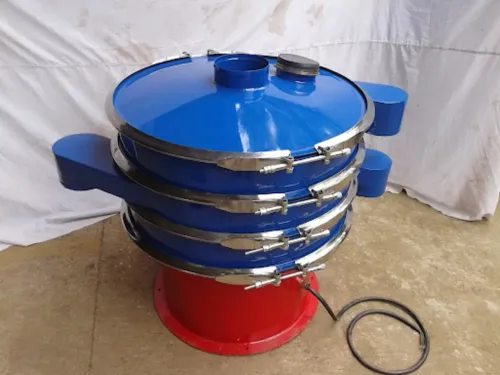
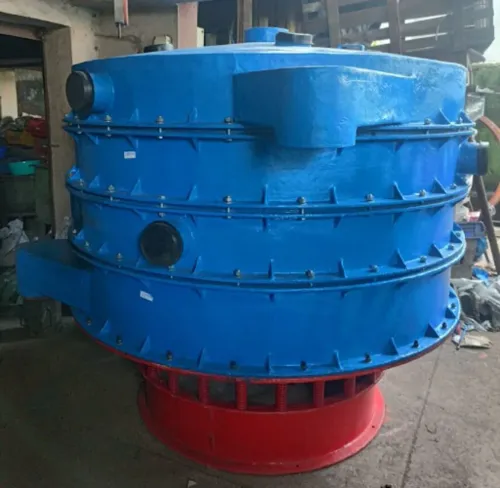
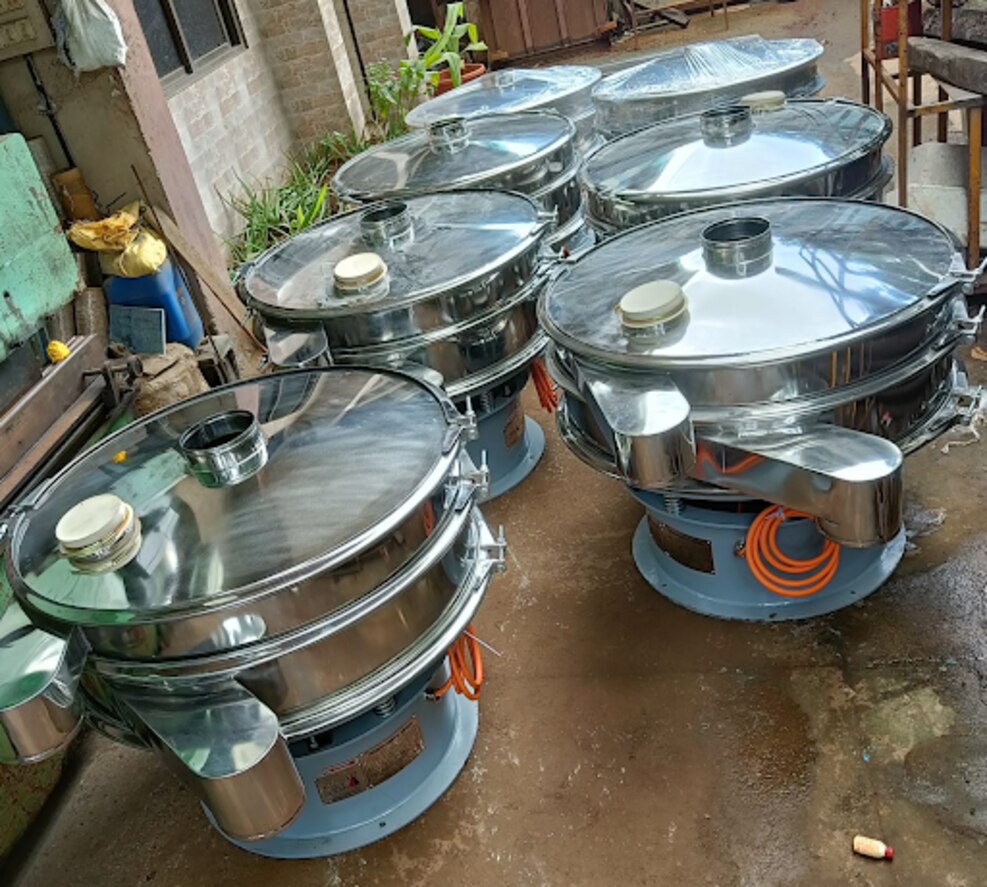
| Multi-deck screener | Several grades in one pass | Each deck adds blinding, wear, leakage, and cleaning points | Multiple grades when each cut has been proven |
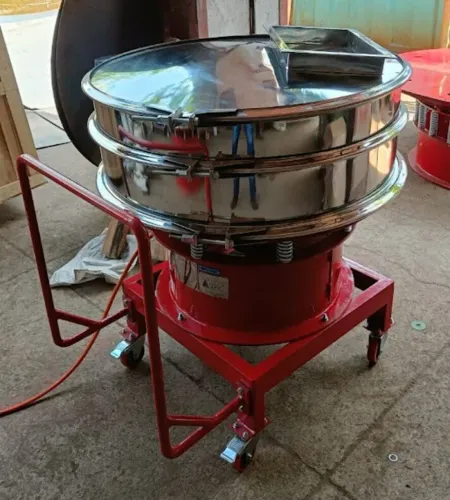
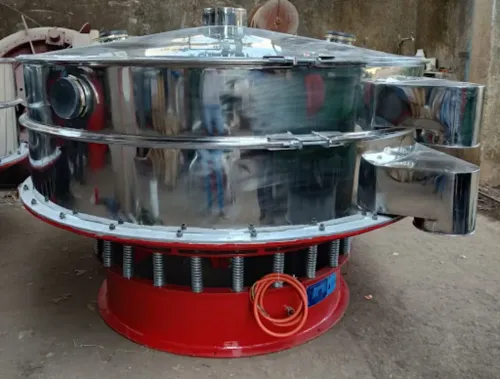
A single-deck and multi-deck screener must also be judged on access. Check sanitary design, product-contact crevices, gasket condition, drainability, and how quickly operators can remove and replace screen cloth.
Require a trial or documented screen validation using the actual spice, target aperture, feed rate, moisture range, acceptable oversize and fines limits, and stated sieve-analysis method. Repeat the analysis during production and after screen replacement; damaged, stretched, blinded, or wrongly installed cloth changes the cut.
Separation Engineers (India) can be included in the comparison, but choose on measured results, sanitary access, screen-change practicality, maintenance records, and repeatability—not high-efficiency claims alone.
Related products
Vibrating Screening Machines Chilly Powder Screening Machine The Chilly Powder Screening Machine by Separation Engineers India is a high-performance vibrating screening system designed to ensure the finest... View product → |
 | Spices Screening Machine The Circular Gyro Screen from Separation Engineers India is a high-performance vibrating screen designed for precise grading, separation, and... View product → |
Frequently asked questions
How does screening change spice particle-size distribution?
Screening separates particles at a defined aperture, allowing undersize material through while retaining oversize material for removal or rework.
How do you verify a spice screen's cut point?
Specify the target aperture and measure the full particle-size distribution of the separated fraction, not only the largest or smallest particles.
Which feed conditions affect screening accuracy?
Feed rate, moisture, temperature, and screen loading affect how consistently particles contact and pass through the screen.
How should grinding, screening, and regrinding be arranged?
Use a controlled route that screens ground material, removes the accepted fraction, and sends oversize particles to defined regrinding rather than uncontrolled recirculation.